Reflection · Mount Baker
The Mountains:
A Mirror of Who We’ve Become
By Mariam Elsharkawy
I am deeply grateful to the Summit Scholarship Foundation for making this mountaineering journey possible.
Whenever I told people that I was going to climb a mountain, their shock was almost always followed by the same question:
“Why?”
At the time, I gave them the answer I understood. I wanted to physically challenge myself and discover what I was actually capable of. But that answer bothered me. There are so many ways I already test the limits of my body. From first learning to skateboard to starting to learn how to scuba dive.
My answer explained why I wanted a challenge, it never explained why I was chasing the mountains.
So why the mountains?
I want to try to put my answer into words.
Once Mount Baker became a real place on my calendar rather than a distant idea, the excuses that had kept me from training rigorously were forced to disappear. Every spare hour became usable. The process taught me, even before I arrived, how much more I could ask of myself.
Still, I knew that the physical challenge was only one part of the pull. I’ve always viewed the outdoors as a sanctuary, a place where movement could quiet my mind and return me to myself. The Summit Scholarship offered me more than just the chance to climb. It created a fully supported, women-centered space where I could step into the unknown.
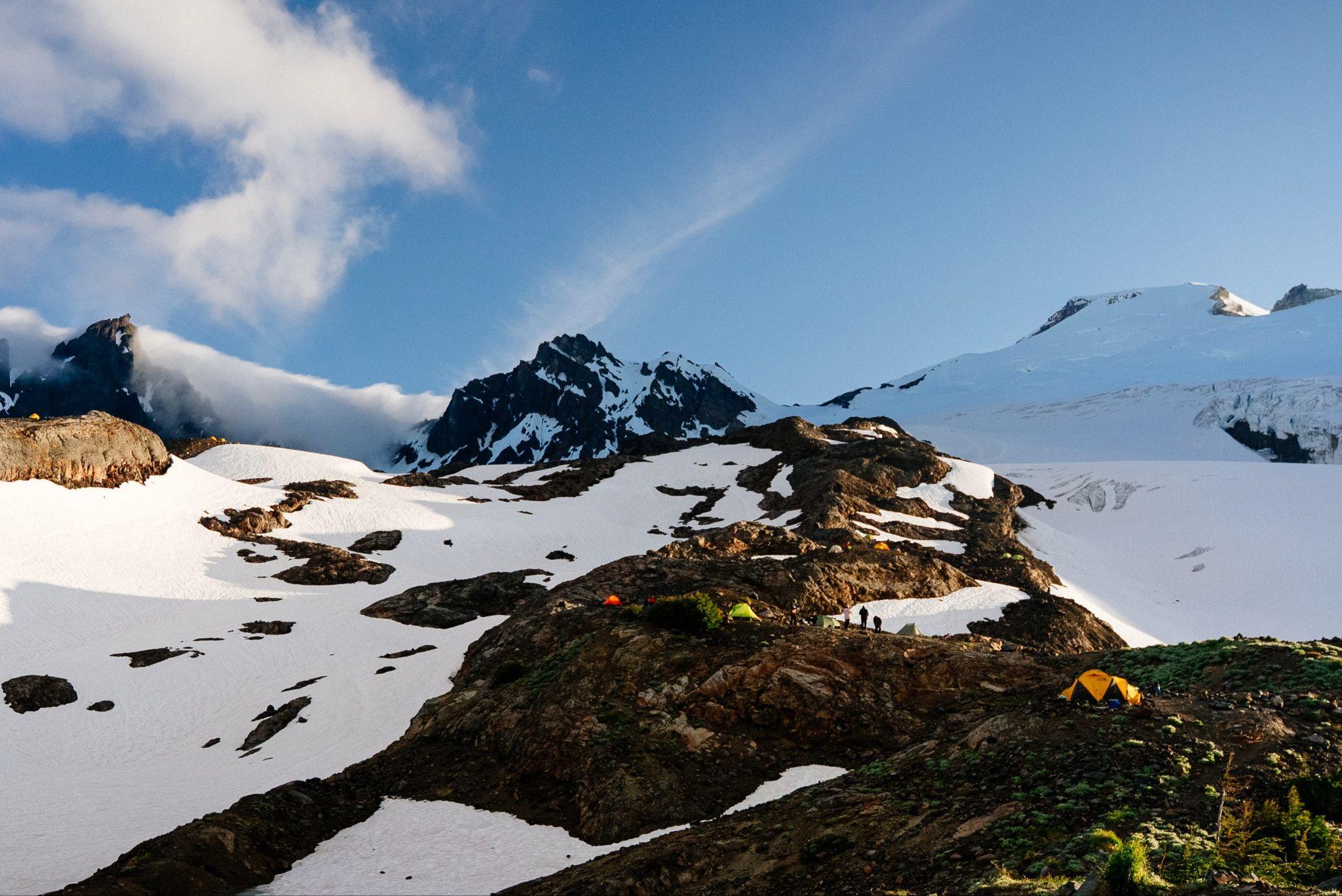
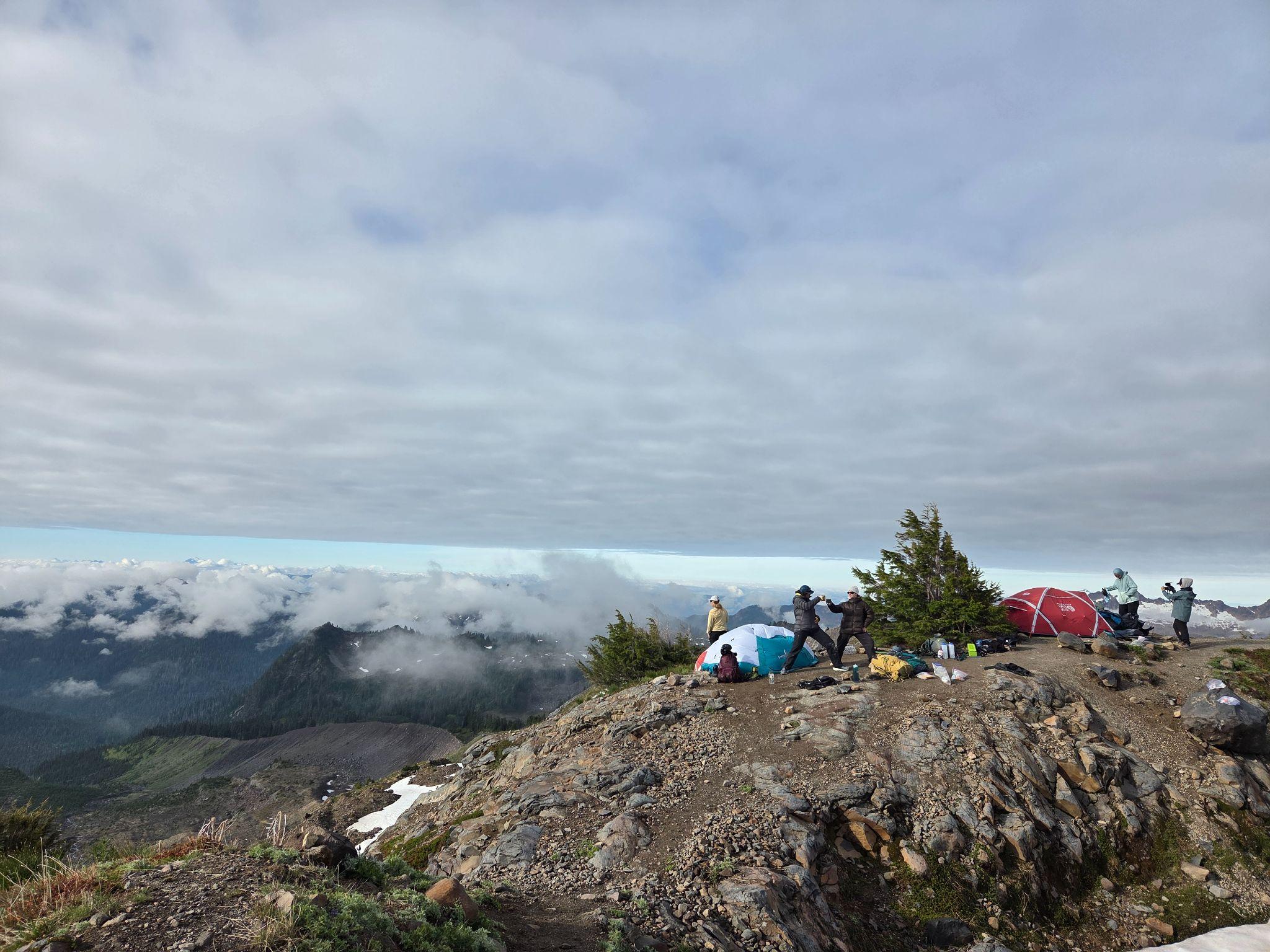
I flew from Houston to Seattle, where I met the other Summit Scholarship recipients and our remarkable guides. The morning after our gear check, we drove to the Park Butte Trailhead and began climbing toward our base camp at 6,000 feet. As we ascended, snow-capped mountains rose around us while thick clouds descended into the valleys and wrapped themselves around the peaks.
Once the trees cleared out, we found ourselves on the railroad grade trail. A steep ridge narrowed beneath my feet. Deep fog covered the cliffs on either side of me, concealing how far the drop continued below, and rain continued to fall around us, slickening the terrain. I could barely see more than a few feet in front of me, our vision so obscured by the rain and fog. The raw beauty of the landscape quickly became inseparable from fear.
My feet balanced on unstable rocks with barely enough space to place one foot in front of the other, carrying a fifty-pound backpack in stiff mountaineering boots that felt far too large and foreign to my feet.
Somehow, in all my excitement, I’d forgotten that I had a fairly harrowing fear of heights.
I’m so accustomed to breaking my comfort zone that I sometimes forget I’m actively breaking it. My defiant refusal to obey my fear of heights hadn’t made my fear disappear. It had merely waited until I stood on the edge of a mountain to come rushing back into me.
I honestly believed I was going to fall off the ridge.
I pulled my hood down around my face to shield my eyes from the cliffs. I couldn’t look at the white, eerie landscape, the exposed knife-edge path, or think about how far there was to fall. My entire world narrowed to Jaz’s shoes in front of me and the next place she set her foot.
Normally, I’m the person trying to make witty comments and filling nervous spaces with humor. On the ridge, that part of me disappeared into silence. There was no joke large enough to protect me from the reality of where I stood. I could only follow Jaz’s feet and trust that she would continue moving at the pace I needed.
That night, I turned to my tentmate, Mary, and admitted that I wasn’t so sure about this whole mountaineering thing. Beneath that confession was a deeper fear: What if mountaineering wasn’t right for me? What if I had wasted a scholarship place on an experience that made me terrified, when someone else might have benefited from it more?
The mountain had begun exposing me before I had even reached the glacier.
There’s something about physical exposure that cuts into the exposure of the self.
On a mountain, there are fewer places to hide from what’s inside you. Fear becomes the slight shaking of your legs. Doubt becomes the next step you hesitate to take. Exhaustion becomes the weight pressing into your shoulders. Everything is bared.
Yet that terrifying first day became one of the greatest blessings of the expedition.
The fear didn’t vanish, but its scale changed everything that followed. After that first spike of real, raw terror, other hardships became strangely manageable. I spent nearly the entire expedition hiking with open-wound blisters that had formed within the first hour of our ascent. I barely thought to mention them. It wasn’t until our final debrief after we got off the mountain, when one of the guides saw my feet and stared at me in disbelief, that I realized an injury like that ordinarily could have put me out of commission.
The weather, meanwhile, was, in the remarkably nonchalant words of one of our guides, “ideal for hypothermia.”
It was relentlessly cold and rainy. Our clothes became problems we had to solve: how to dry them and how to convince ourselves to pull them back on the next wet morning. There wasn’t a warm house waiting at the end of the day. Our bodies became the only stable source of heat we had, both for ourselves and for the clothes we would need to wear again.
That physical reality led me toward one of the quietest but most transformative conclusions of the expedition: we can’t separate the inside from the outside as neatly as we pretend.
In daily life, it’s easy to compartmentalize discomfort. We can change out of wet clothes, retreat into a warm room, or distract ourselves from what we feel. On the mountain, the exterior world kept revealing my interior one. The condition of my clothes, the steadiness of my feet, the way I responded to fear, and my willingness to trust the women around me were all visible. The mountain made it harder to leave my full self behind.
That mattered because I had spent much of the preceding years trying to do exactly that.
I had entered my twenties amid an intense shift in my identity. Over the preceding months and years, messy semesters and broken friendships had unsettled parts of myself that I once considered permanent. I was changing in ways that felt core and meaningful to me, but not everyone around me understood those changes. Because they couldn’t always recognize who I was becoming, sometimes I wondered whether I understood myself.
That uncertainty left me searching for a source of grounding beyond the perceptions of the people around me. On Mount Baker, I found myself returning to my religion’s description of mountains as pegs that anchor the earth. My faith gave me a language for understanding that what anchors us may lie deeper than what can be seen from the surface. The mountains pulled me beneath the shifting surface of other people’s expectations and my own uncertainty, back toward a sense of self rooted in my own convictions and in God. The mountains couldn’t answer my questions I had about who I was becoming. But they anchored me in place long enough to stop running from those questions.
The same landscape that anchored me was undergoing a slow transformation of its own. The glacier revealed a landscape being reshaped over time, gradually enough that I could stand within the process without seeing its full arc. The mountains became a mirror because their slow transformation gave me a larger scale through which to understand my own. What had felt like the sudden loss of a stable identity could also be understood as the gradual formation of one.
Their rawness reflected the parts of me I could no longer soften for other people. High above my ordinary life, I could sit with the person I was becoming without immediately trying to make her understandable to everyone else.
Our guide, Mary, later told us that, in less than 150 years, the glaciers surrounding us in the Pacific Northwest may cease to exist. Our grandchildren may never see them in their full, raw beauty. I’m certain that I didn’t even see the glacier in its full, unaltered form.
Learning that the glacier itself might disappear made the parallel between its transformation and my own more unsettling. The glacier’s slow transformation was also a real loss, and I owed so much personal change to a landscape that was itself melting away. Yet its impermanence didn’t make what it had given me less real. A place can be disappearing and still anchor a life. Perhaps its impermanence should make us pay closer attention while it’s still here.
Once I began to understand transformation as gradual and cumulative, I stopped expecting the summit to deliver it all at once.
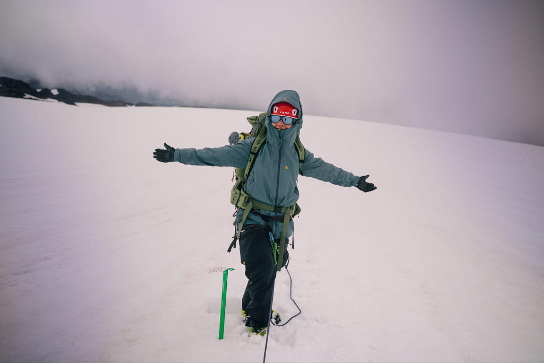
I had once imagined that the meaning of the climb would reach its climax at the summit, as if I were a character in a story who would arrive at the peak and finally have everything revealed to her. But the weather remained too risky for a summit attempt. Instead, after learning glacier travel, ice climbing, self-arrest with an ice axe, and how to move tied together in a rope team, we spent the day exploring and ascending portions of the Easton Glacier. The weather transformed the terrain until it seemed as though we had been transported into an Arctic tundra, far beyond the world we had left below.
There wouldn’t be a summit photograph. No single moment when every uncertainty in my life suddenly resolved itself.
But perhaps that was the more honest lesson.
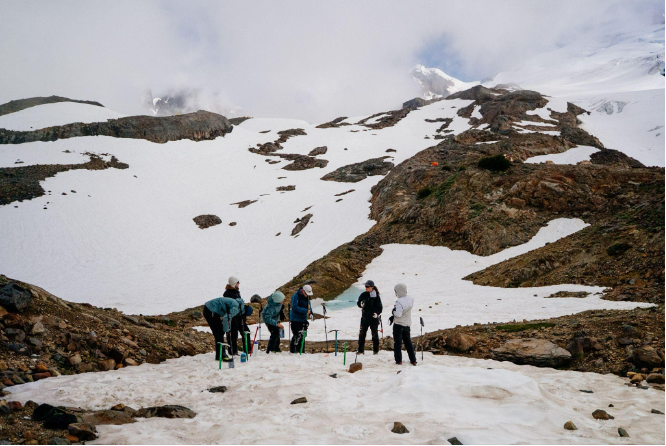
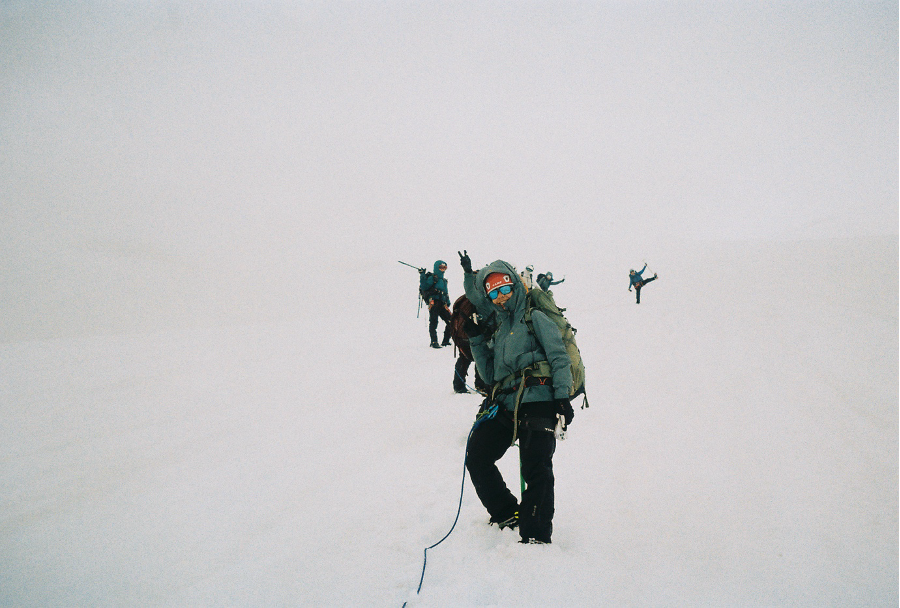
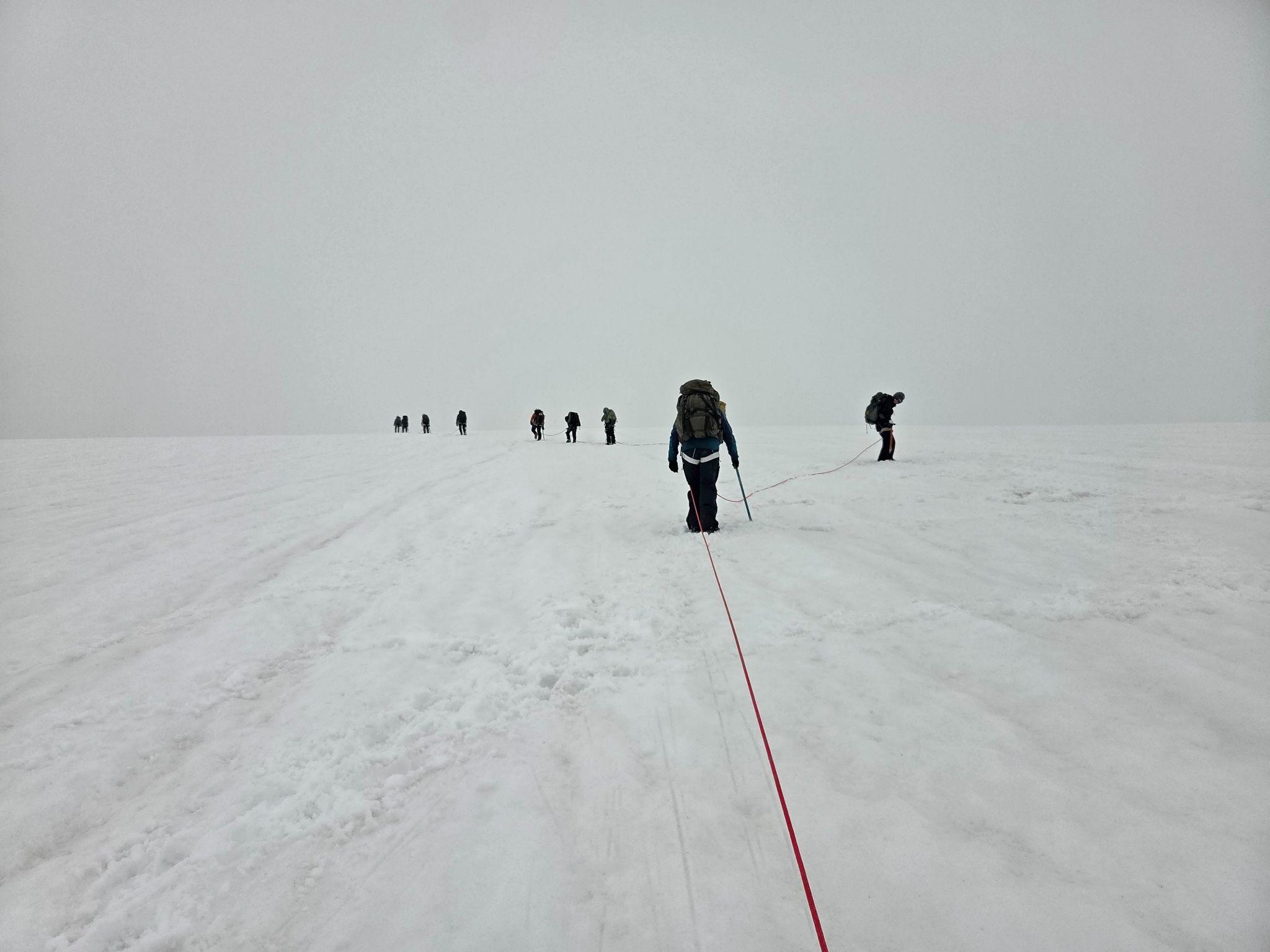
The same mountain that exposed us individually also bound us together.
On our first day, we were strangers. I remember the first night at the hotel, being taught how to pack my backpack by women I had just met and slowly getting to know the person who would share my tent. Those memories are now almost impossible to reconcile with the women I left only a few days later.
Jaz’s shoes on the ridge were my first lesson in what a rope team could mean, even before we physically tied ourselves together. Later, on the glacier, that trust became literal. A rope team is not simply a metaphor for connection. You’re attached to one another. You carry responsibility for other people’s safety while allowing them to carry responsibility for yours.
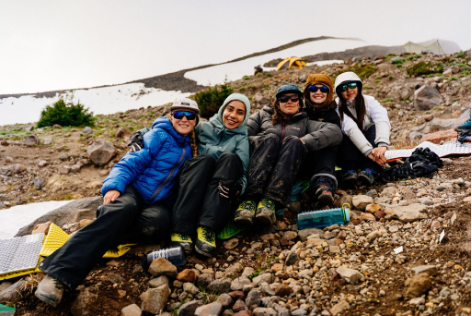
The distance between us disappeared as we camped beside one another, endured the same cold, and learned to place our lives in each other’s hands. When solace couldn’t be found in the weather, we found it in one another.
During our ascent, one of the girls told me that I was the first person she had spoken with who wore a hijab. She asked me what it was called and what it meant.
High on Mount Baker, where I doubted anyone else looked quite like me, I felt honored to represent my faith and community. I often catch myself self-censoring my Islam, minimizing parts of myself to preserve other people’s comfort. But standing there, surrounded by mountains that drew me more deeply into awe of God’s creation, I didn’t want to step outside my faith to belong in the outdoors. I was there in my hijab, learning to cross a glacier and tie into a rope team, openly carrying my faith into a landscape where it had every right to exist. I didn’t need to leave part of myself at the trailhead to make room for everyone else. Sometimes representation is simply the decision to arrive as your whole self in a place where no one expected to find you.
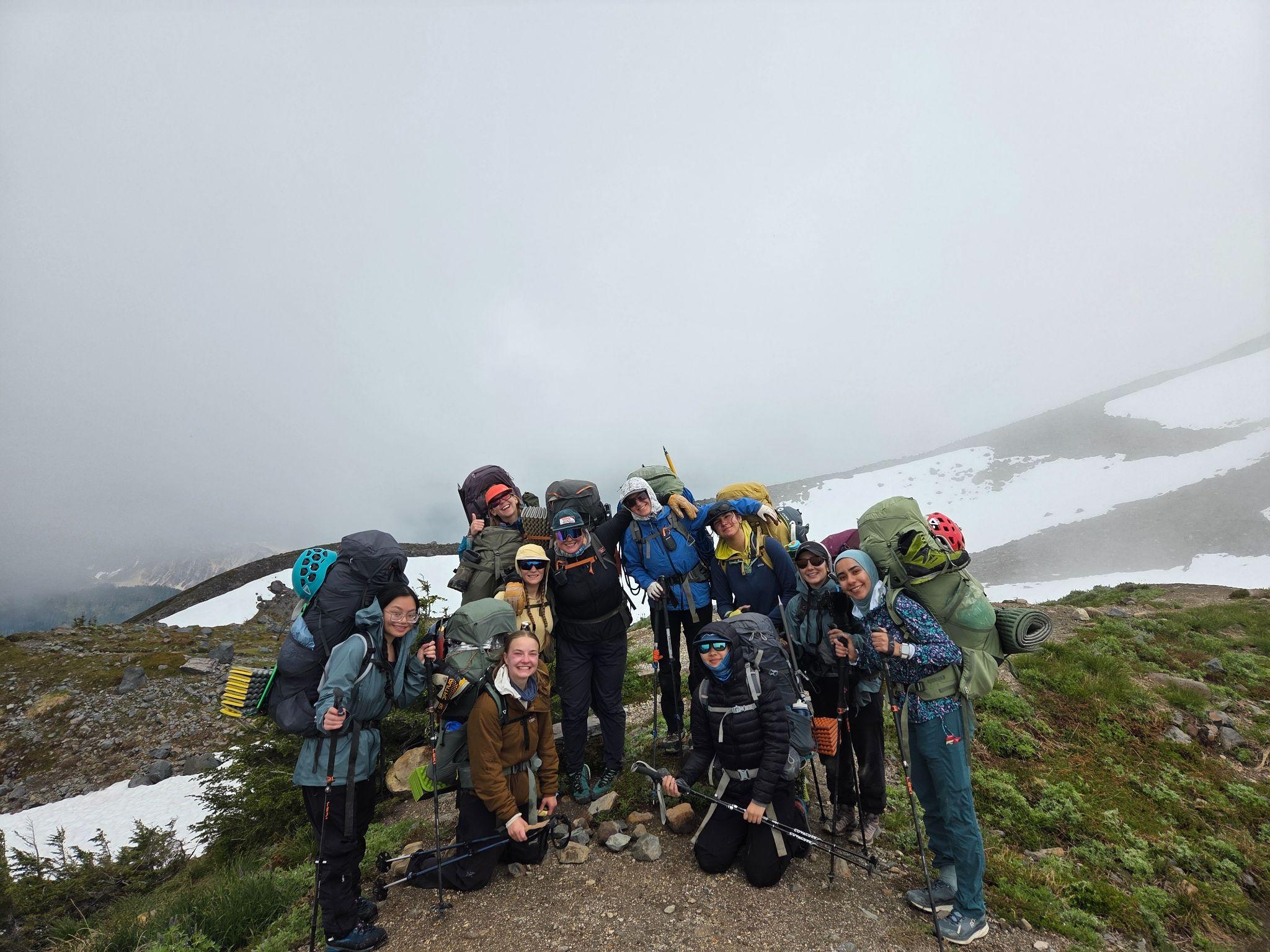
On the final day, we descended by the same route that had terrified me on the way up. This time, the fog had cleared. I could finally see the valley below us and the long, parallel track of the Railroad Grade stretching through the landscape. I couldn’t stop smiling! I was so giddy that I recorded nearly fifteen minutes of the descent with one hand, astonished by everything that had been hidden from me before.
The trail was still narrow. The cliffs had always been there. But now I could finally see them.
My feet felt steady and confident inside the same boots that had seemed clunky and foreign only days earlier. I placed one foot in front of the other without needing to control every part of what lay ahead.
The descent gave physical form to something my faith had long asked of me. We don’t always get to see the entire landscape with the clouds removed. There will be moments when the sky opens and we are allowed to marvel at the wisdom behind what we have endured. There will also be times when clarity doesn’t arrive, when the meanings of our individual journeys remain beyond our sight. But the mountain, in all its glory and magnificence, is still there when we can’t see it.
Trusting God doesn’t mean expecting every cloud to lift on my schedule. It means learning not to mistake what is hidden for what is absent. I can exhaust myself trying to control every unknown outcome, or I can continue placing one foot in front of the other, trusting that there is a landscape to marvel at beyond the fog.
After descending, we ate dinner together at a restaurant and returned to our hotel for one final debrief. We laughed and shrieked as we lowered our exhausted bodies into the soothing water of the hot tub, then dared one another to jump into the cool pool beside it. We were trying to relish each other’s company and our strange reintroduction to the modern world. None of us seemed ready to leave, even after the cold and rain.
The mirror of the mountain had been plural all along. Each of us had arrived carrying a self already in motion. I can’t speak to the stories of everyone else’s transformations, but I watched strangers become women I trusted with my life. We didn’t return as untouched versions of the people who had started the climb.
I think back to that first night, when I worried that my fear made me undeserving of the scholarship. Now I believe almost the opposite. Transformative experiences aren’t meant exclusively for people who already feel confident that they belong. Sometimes the person who needs the mountain most is the one who arrives with doubts they haven’t yet uncovered.
I didn’t stand on Mount Baker’s summit. But I returned home unable to stop talking about the mountains I want to climb next. My family now complains that nearly every conversation with me eventually becomes a conversation about my excitement for mountaineering.
The Summit Scholarship gave me far more than an expedition. Kat, Dani, Mary, and Carly, our truly amazing guides, gave us the knowledge and trust to enter a world none of us could have entered alone. Mary, Abi, Natalia, Jaz, and the other women beside me gave the mountain its warmth and belonging when the weather offered none.
I went to Mount Baker expecting the summit to tell me who I was. Instead, the mountains reflected who we had already been becoming.
Afraid, but moving.
Unsteady, but learning where we were rooted.
Changing slowly beneath the surface, but never abandoning ourselves.
I am deeply grateful to the Summit Scholarship Foundation for making this mountaineering journey possible.